These Days Bureau
Summit highlights low private sector R&D spend and urges stronger collaboration to raise research expenditure beyond 2% of GDP.
New Delhi: The Federation of Indian Chambers of Commerce & Industry (FICCI) brought together government officials, researchers, and corporate leaders at the inaugural Bharat R&D Summit 2025 in New Delhi. With the theme “Innovating Together: Industry–Academia Collaboration,” the summit underscored India’s pressing need to boost R&D through stronger partnerships and sustained investments.
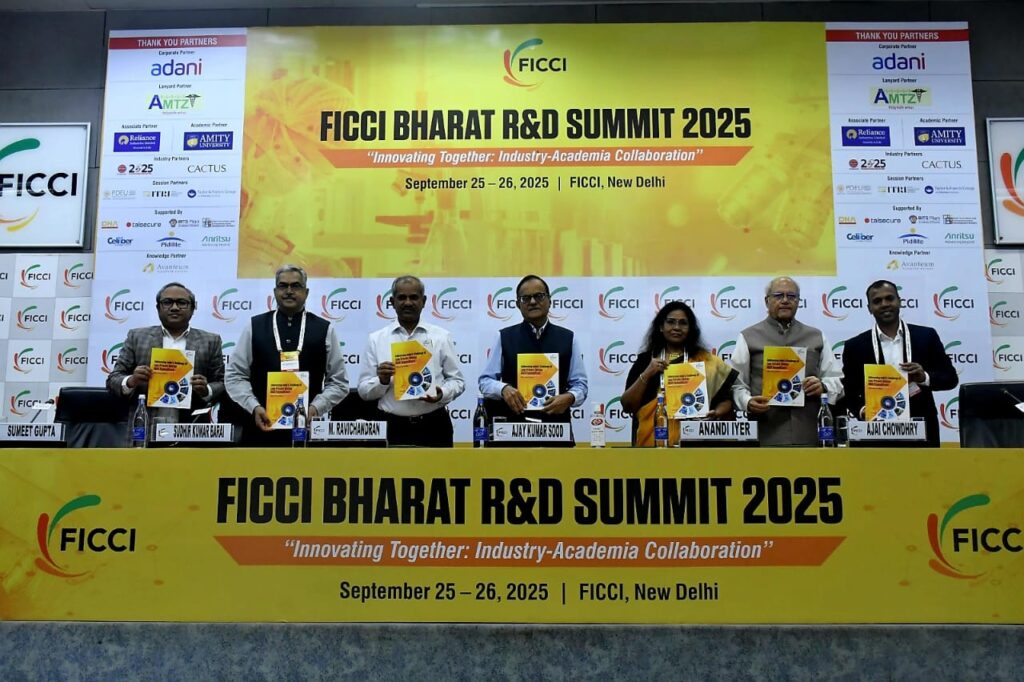
Prof. Ajay K Sood, Principal Scientific Adviser to the Government of India, highlighted that India’s Gross Expenditure on R&D (GERD) stands at 0.7% of GDP, with less than 40% contributed by industry. “India must move beyond incremental work. Industry has to invest boldly in deep-tech and product-driven research in semiconductors, clean energy, biotechnology, and AI,” he said, citing initiatives like the National Research Foundation and the ₹1 lakh crore deep-tech corpus as key enablers for impactful partnerships.
Dr. M. Ravichandran, Secretary, Ministry of Earth Sciences, Government of India stressed the importance of breaking silos across academia, industry, and government to meet Vision 2047 goals of sustainable growth and global leadership.
“India’s oceans hold immense potential—from sustainable fisheries and deep-sea resources to ocean-based renewable energy. Industry must actively engage alongside initiatives like the Deep Ocean Mission to unlock these opportunities sustainably.”
Dr. Ajay Chowdhry, Co-founder of HCL and Chairman of the National Quantum Mission Governing Board, emphasized that India must transition from a services-led economy to a product nation to secure technology sovereignty. He said, “Overdependence on services is no longer sustainable. Large-scale investments in deep-tech and product development are key to global competitiveness,”. He highlighted progress under the National Quantum Mission, including support for 104 quantum startups, semiconductor incentives, and the forthcoming R&D Innovation Fund, which will match government and private sector investments.
Ms. Anandi Iyer, Co-Chair of the FICCI Innovation Committee and Director, Fraunhofer India Office, underscored the triple helix model and the need for higher industry investment to strengthen India’s innovation ecosystem. She said, “While India’s academia excels in fundamental research and our industry is entrepreneurial, R&D expenditure is just 0.8% of GDP. Industry must step up to raise it beyond 2% in the next decade.”
Prof. Sudhir Kumar Barai, Co-Chair, FICCI Innovation Committee and Director, BITS Pilani, offered closing remarks for the day. He said, “Industry participation is essential for impactful research. By fostering startups and engaging with platforms like the innovation exhibition, we can translate academic innovation into real-world solutions and address national challenges.”
At the summit, FICCI unveiled a compendium of technologies for commercialization along with the release of a discussion paper titled “Addressing India’s Challenge of Low Private Sector R&D Expenditure”, which examines the barriers to higher industry participation in research and outlines actionable measures to strengthen India’s innovation ecosystem.
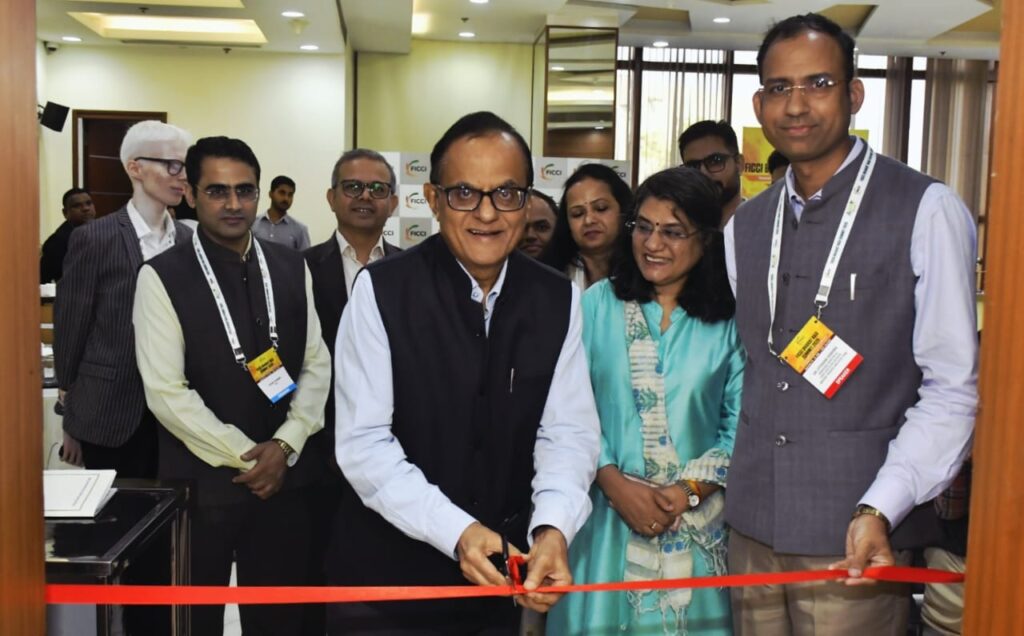
The summit also featured an impressive exhibition showcasing over 60 cutting-edge research projects by the country’s leading academic and research institutions. These cutting-edge advancements spun across wide range of critical domains, including clean energy solutions, next-generation healthcare advancements, agriculture and food security, defence, advanced robotics, water and waste management and others.
FICCI reaffirmed its commitment to fostering industry–academia partnerships to accelerate India’s innovation-led growth.