These Days Bureau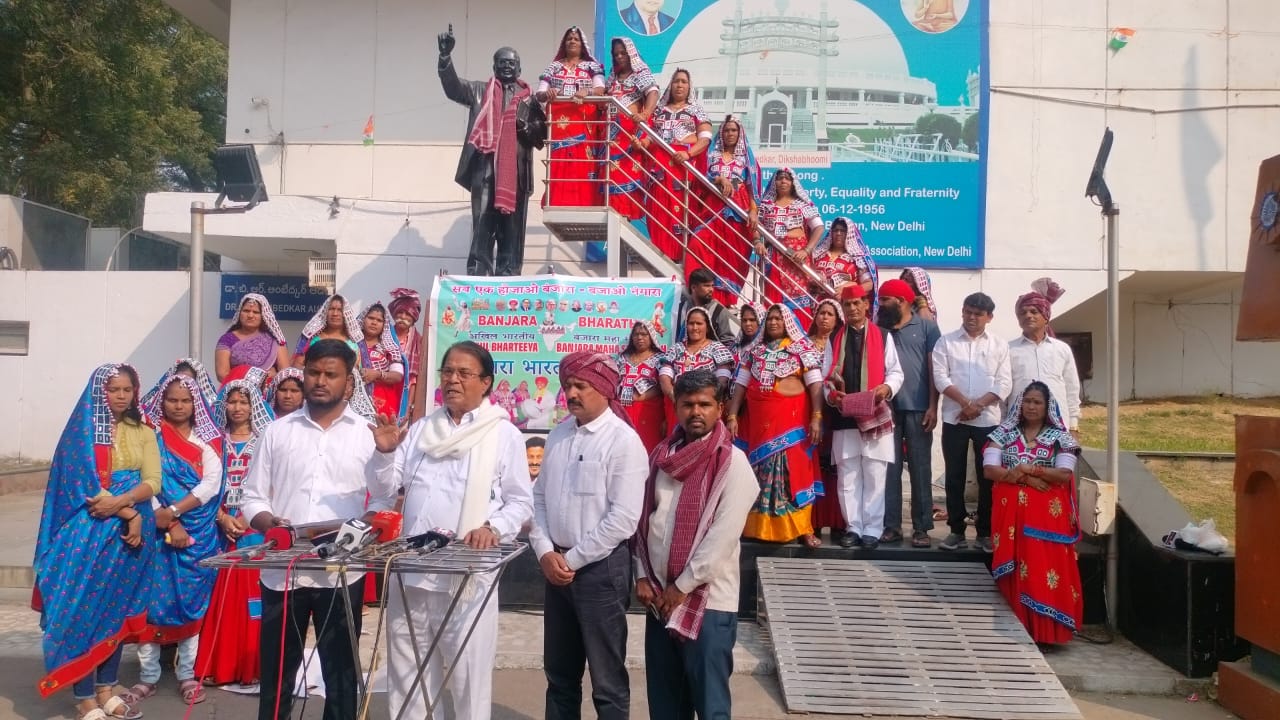
Banjara community leaders from across India gathered in New Delhi to launch the national campaign, seeking settlement of historic land claims, cultural preservation, national recognition, and socio-economic development measures.
New Delhi, 29 November 2025
The “Hello Banjara – Chalo Dilli / Delhi Aao Banjara – Bajao Nangara” campaign was officially launched today in New Delhi, with the national poster unveiling event organized by Banjara Bharat and the newly formed Akhil Bharatiya Banjara Maha Seva Sangh. Representatives of the Banjara community from across the country attended to highlight long-standing socio-economic challenges and present a consolidated set of demands to the Government of India.
Former MP and Banjara Bharat patron, Ravindra Naik, emphasized that even after eight decades of independence, many Banjara settlements—including Tandas, Naglas, and Deras—spread across nearly 20 states still lack fundamental amenities such as drinking water, roads, electricity, healthcare, and education. He added that while the community shares a rich cultural and linguistic heritage, its classification under different categories—SC, ST, OBC, and VJNT—across various states has kept it politically and socially marginalized. With significant populations in almost 200 parliamentary and 1,000 assembly constituencies, the community continues to face neglect.
The event also paid tribute to Lakki Shah Banjara, whose historic Tanda once spanned 350 acres in the area now known as Raisina Hills, home to Rashtrapati Bhavan, Parliament House, and other major national institutions. Organisers stressed the urgent need for settlement of pending land compensation, noting that only a portion of the land was ever allocated.
Community leaders urged the government to preserve Banjara-associated heritage sites across India, including Lohagarh (Haryana), Mangarh (Rajasthan), Lakhi Sarai (Bihar), Mathura–Vrindavan (Uttar Pradesh), Sagar Lakki Shah Lake (Madhya Pradesh), Banjara Hills and Golconda Gate (Telangana), Baba Hathiram Math (Tirupati), and Kadambur Hills (Tamil Nadu).
The charter of demands calls for the inclusion of Banjara/Gor Boli in the Eighth Schedule of the Constitution, referencing a resolution recently passed by the Telangana Assembly. It also advocates for uniform national recognition of all sixteen Banjara sub-groups, under the principle of “One Nation, One Banjara,” to remove inconsistencies in constitutional status across states.
Other key demands include the establishment of a National Banjara Tanda–Nagla–Dera Development Board to ensure essential services in settlements nationwide, and the creation of National Banjara Museum and National Banjara University in Delhi and Hyderabad to promote cultural research and education. Organisers also sought official identity cards and structured protection for itinerant Banjara youth engaged in hawking and small trades.
Highlighting the low literacy rate among Banjara women, the community demanded Banjara Women’s Residential Schools in 200 district headquarters. Additional proposals included naming prominent roads in the National Capital Region after Banjara icons, forming a National Banjara Research and Development Commission, installing statues of Lakki Shah Banjara and Makkan Shah Lubana in the Parliament complex, naming a national train “Banjara Bharat Rail”, and creating a Banjara Regiment to honor the community’s martial legacy.
The campaign concluded with a message of unity and collective action, urging the central government to take swift steps to resolve historical, cultural, and development-related concerns of the Banjara community.