These Days Bureau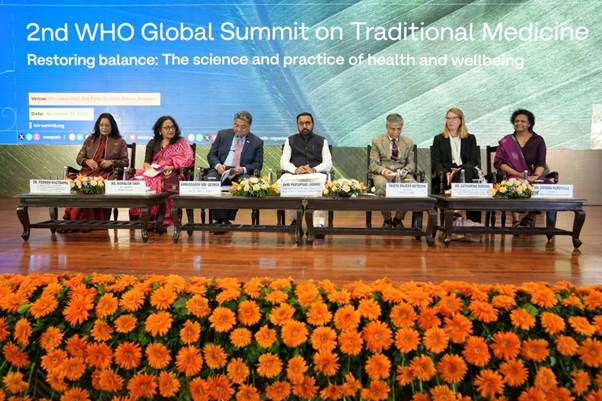
India is spearheading international efforts to integrate traditional medicine into modern healthcare systems through rigorous research, enhanced safety standards, and worldwide collaboration, as highlighted during a high-level Ambassadors’ Reception hosted by the Ministry of Ayush in partnership with the World Health Organization (WHO). The event, held in the national capital, served as a prelude to the 2nd WHO Global Summit on Traditional Medicine, set for December 17–19, 2025, in New Delhi.
Union Minister of State (Independent Charge) for Ayush and Health & Family Welfare, Shri Prataprao Jadhav, addressed the gathering of ambassadors, high commissioners, and diplomats, emphasizing the summit’s role in promoting equitable and accessible healthcare. He described traditional medicine as a vital blend of cultural heritage and scientific innovation, noting India’s close work with WHO and the Global Centre for Traditional Medicine in Jamnagar to bolster research and quality assurance for global benefit.
Secretary of the Ministry of Ayush, Vaidya Rajesh Kotecha, aligned the summit’s theme—”Restoring Balance: The Science and Practice of Health and Wellbeing”—with a commitment to holistic health. He expressed confidence that the upcoming global dialogue would drive meaningful cooperation in standard-setting, research advancement, and quality control.
Dr. Poonam Khetrapal, Regional Director Emeritus for WHO South-East Asia and Senior Advisor on Traditional Medicine to the WHO Director-General, underscored traditional medicine’s centrality to achieving “Health for All.” With 170 WHO member states reporting its use, she praised initiatives like the Jamnagar centre and the Traditional Medicine Global Library as key to evidence-based, people-centered care.

Ambassador Sibi George, Secretary (West) in the Ministry of External Affairs, highlighted India’s influence in global frameworks, integrating ancient healing practices with modern science to support universal health coverage. He commended the Ministry of Ayush for its progress in pharmacovigilance and international partnerships.
Dr. Shyama Kuruvilla, Director of the WHO Global Traditional Medicine Centre, outlined the summit’s focus on restoring balance for people and the planet, aligned with the Global Traditional Medicine Strategy 2025–2034. The event will showcase cutting-edge evidence, innovations, and solutions to pressing challenges.
Joint Secretary Monalisa Dash from the Ministry of Ayush provided details on anticipated participation, thematic sessions, major announcements, and partnerships. The reception concluded with remarks from Dr. Catharina Boehme, Senior Advisor to the WHO Director-General and Officer-in-Charge for WHO SEARO, who called traditional medicine essential to inclusive global health systems and urged high-level ministerial engagement.
The gathering reinforced a unified global commitment to synergizing traditional knowledge with contemporary science, with the Ministry of Ayush urging diplomatic missions to ensure robust government representation at the December summit.