These Days Bureau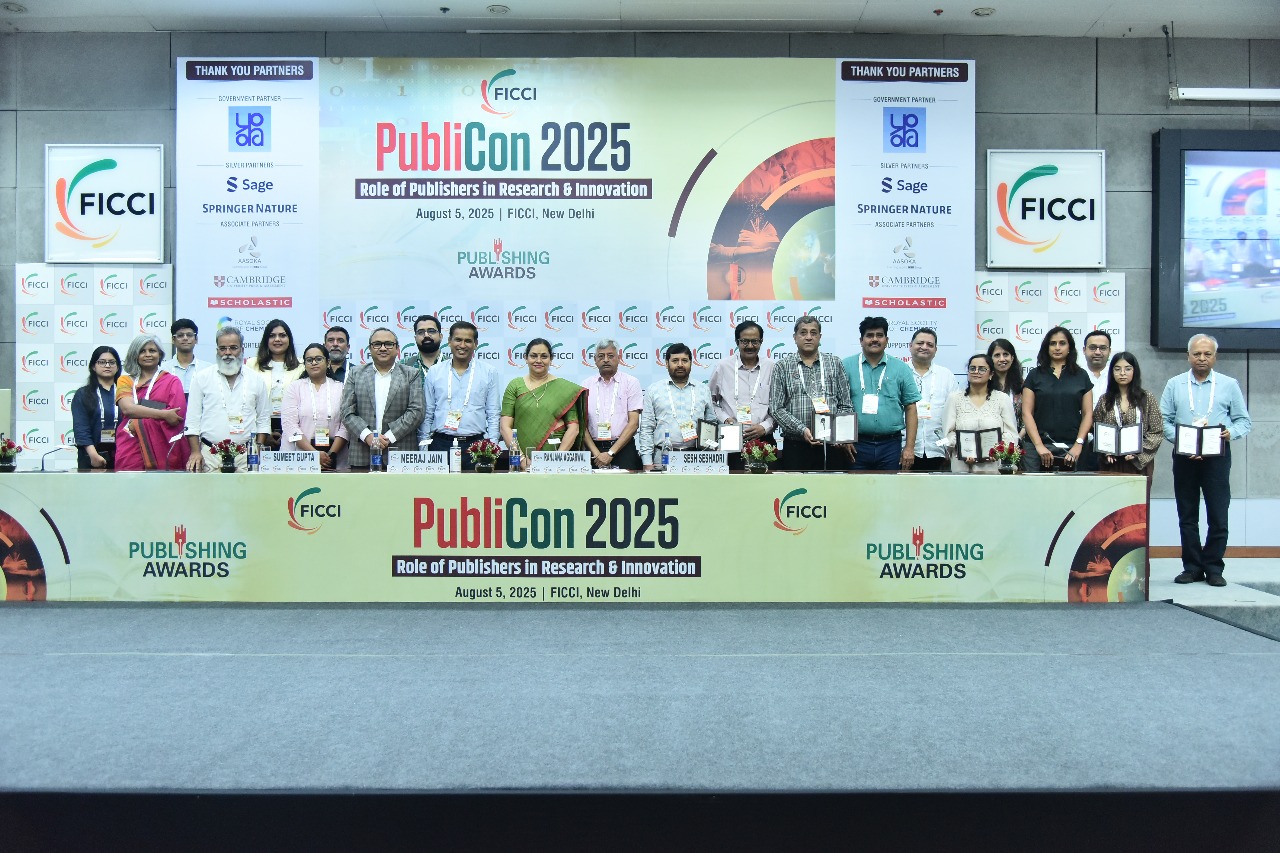
Publishers to address critical challenges of accessibility, affordability, and international visibility to foster greater knowledge equity: Dr Ranjana Aggarwal, Outstanding Scientist, CSIR, Ministry of Science & Technology, GoI
New Delhi, 05 August 2025
FICCI today organized ‘PubliCon 2025’, the annual flagship conference on publishing with the theme- ‘Role of Publishers in Research & Innovation’.
As part of PubliCon 2025, the FICCI Publishing Awards 2025 were presented to outstanding contributions across the Indian publishing landscape. The awards spanned a wide range of categories, including Children’s Books (in English and Hindi, for readers below and above 10 years), Fiction and Non-Fiction (in both English and Hindi), and Business Books (covering Self-Help, Economics, Management, and Biography). Additional categories recognised excellence in Translation, Comic/Graphic Novels, and Design and Production, such as Best Cover Design, Best Overall Design, and Best Printed Book.
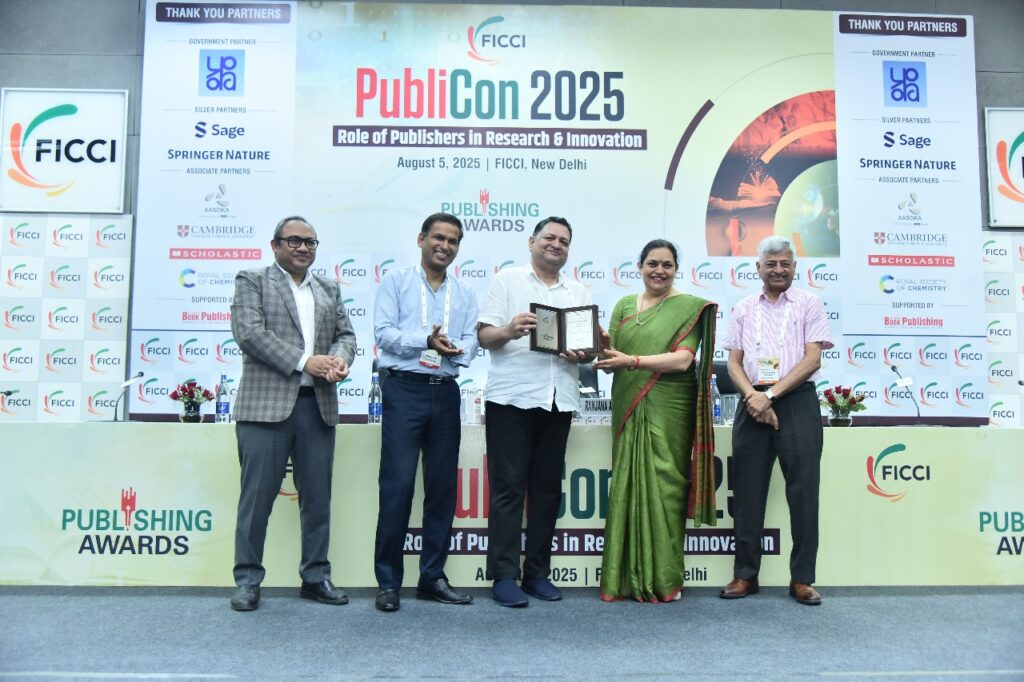
Addressing the gathering, Dr Ranjana Aggarwal, Outstanding Scientist, CSIR, Ministry of Science & Technology, Govt of India emphasized the importance of inclusive publishing—with a particular focus on Indian languages—and the integration of indigenous knowledge systems into mainstream academic and research discourse. She urged publishers to address critical challenges such as accessibility, affordability, and international visibility to foster greater knowledge equity.
Mr Neeraj Jain, Chair of the FICCI Publishing Committee and Managing Director, Scholastic India, set the tone for the day by calling for a more expansive and forward-looking view of publishing. He emphasized that publishing today goes beyond books — it plays a pivotal role in building a robust knowledge ecosystem that supports research, innovation, and national growth. Citing the effective collaboration during the implementation of the National Education Policy (NEP), Mr Jain urged publishers to act not just as content providers but as equal stakeholders in India’s development story.
Ms Shilpy Kochhar, Head – Business Development & Communications at BIRAC, emphasised the need for stronger science communication to bridge the gap between innovation and society. Highlighting BIRAC’s support for over 12,000 biotech start-ups, she called on publishers to simplify complex research, promote multilingual content, and focus on real-world impact beyond academic metrics. She urged greater collaboration between publishers and innovation agencies to make science accessible, inclusive, and engaging for wider audiences.
Speaking during the panel discussion on ‘Challenges and Opportunities for STM Publishers’ at PubliCon 2025, Ms. Qudsia Ahmed, Head of Academic Publishing at Cambridge University Press, highlighted the need for publishers to bridge gaps in accessibility, affordability, and discoverability, particularly in the Global South.
Dr. Sugata Ghosh, Deputy Managing Director, SAGE South Asia, emphasised the need for stronger institutional and policy-level support to strengthen open access publishing in the region. He identified diamond open access—where neither authors nor readers pay—as the most viable and sustainable model for India, calling for collaborative efforts among stakeholders to make knowledge freely accessible.
Mr. Venkatesh Sarvasiddhi, MD of Springer Nature India, underscored the urgent need for a national open access policy to combat predatory publishing and enable a phased transition to OA. Highlighting limited research funding and lack of grant support for publishing, he advocated for regional pricing and a shift in library roles. He welcomed initiatives like One Nation One Subscription and noted that an OA policy is expected soon.
Mr. Madhvendra Narayan from the Indian National Science Academy noted that while technology has streamlined workflows and expanded global access through platforms like Springer, the fundamentals of publishing remain the same. He also pointed out the absence of clear national policy on emerging manuscript practices in India.
The event brought together key stakeholders from publishing, academia, research, and policy to discuss the evolving role of the publishing industry in strengthening India’s knowledge economy.
A copy of the awardees list is also attached for your reference.