These Days Bureau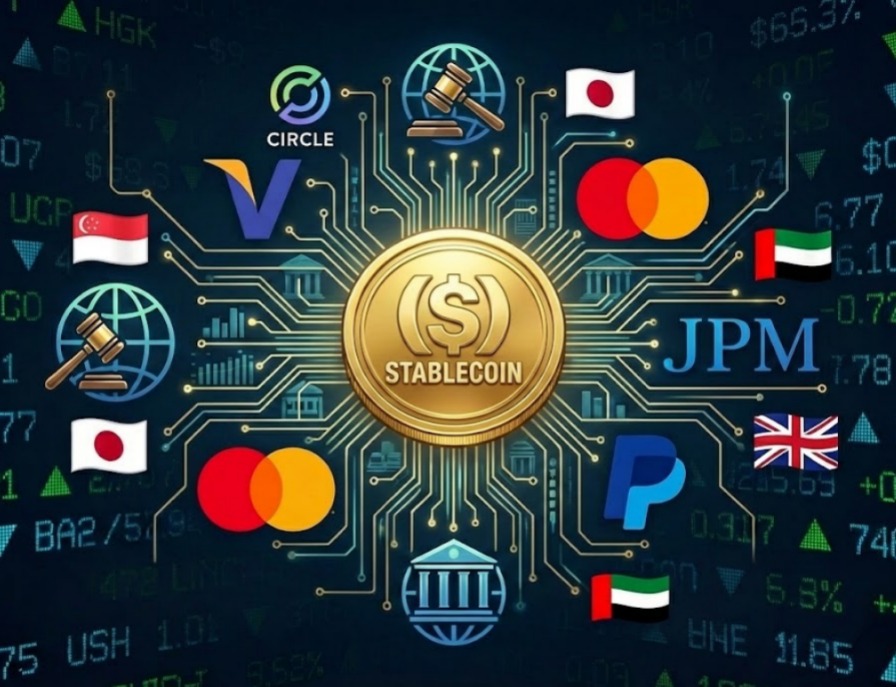
Stablecoins Transition from Crypto Niche to Core Infrastructure for Cross-Border Value Transfer
New Delhi: Entering 2026, it is impossible to envision discussions on the future of finance without considering the institutional rise of stablecoins. The major shift of the past year is clear: stablecoins are now controlled and directed by the key players at the core of global finance.
While early stablecoin markets were characterised by offshore issuance, fragmented governance, and regulatory ambiguity, today the momentum lies with global card networks, systemically important banks, and regulated fintechs. They view stablecoins not as substitutes for money, but as more efficient delivery mechanisms for it. The conversation has now moved from “whether” to “how.”
Visa, usually the quiet incumbent, has solidified its position as one of the most consequential forces accelerating stablecoin adoption. Its network experiments with USDC began with modest settlement pilots, but throughout 2025, Visa transformed these trials into a pragmatic strategy: using blockchain rails to move value between its global settlement hubs. The company’s pitch remains disarmingly simple: if a dollar is a dollar, and a stablecoin dollar moves instantly, why cling to the frictions of correspondent banking? Visa now collaborates with Circle and several regulated stablecoin issuers, effectively operating a two-layer system where traditional card payments ride atop tokenised settlement flows. To the average consumer, nothing appears different; to treasurers, the speed and cost advantages have proven impossible to ignore.
Mastercard’s trajectory remains more sceptical yet equally critical. Rather than fully embracing any single stablecoin, the company has focused on maturing its “multi-rail” infrastructure, letting banks and wallets plug in whichever tokenised asset they trust. Mastercard’s stablecoin integration framework, which scaled significantly over the last year, provides a predictable compliance perimeter: KYC in, risky addresses out, and real-time sanctions screening baked into the chain itself. It is, in many ways, the most Mastercard-like response imaginable—less evangelical, more supervisory, yet deeply strategic. While Visa built speed, Mastercard built guardrails, becoming the preferred conduit for institutions that wanted exposure without chaos.
On Wall Street, the most serious private-sector contender remains JPMorgan’s tokenised dollar, JPM Coin. While still confined to the bank’s massive corporate client base, the numbers entering 2026 are impressive: trillions of dollars in intraday flows, cross-border liquidity movement, offshore dollar pooling, and repo transactions. Crucially, JPM Coin is not a public stablecoin—there is no retail access, no open market—but it signals the dominant direction of travel: the dollar has become an instrument that lives natively on programmable, always-open networks. As the world’s largest correspondent bank shifted its own plumbing, others have followed.
If JPMorgan represents the institutional end of the spectrum, PayPal embodies the consumer-facing frontier. The release of PYUSD in 2023 was dismissed by many as a late and tepid entry; by 2026, the narrative has firmly flipped. For PayPal, PYUSD has proven to be less a crypto token and more a strategic wedge—one that helped it claw back ground lost to real-time domestic payments and low-cost fintech rails. For regulators, PYUSD offered a vital case study: what happens when a household brand issues money that circulates globally without touching a bank’s payment rails? The answer is that the walls between “financial institution” and “issuer of digital money” have blurred faster than supervisors expected.
The global picture now pulls towards mass adoption, acceptance, institutional alignment, and business opportunities. In Singapore, Japan, the UAE, and the UK, regulators have moved past rule-writing to enforcement and oversight. The logic is simple: if the private sector insists on issuing money, the state insists on maintaining the constitution for it.
Together, these developments reveal a shift that is broader than any single issuer. Stablecoins are no longer a corner of crypto; they have become an operating system for global value transfer. The architecture of money has fragmented, recombined, and modernised quietly, and all at once. Stablecoins are no longer passengers in the financial system. They are the engine.