admin
admin
Mokama-Munger High-Speed Corridor and Bhagalpur-Dumka-Rampurhat Railway Line Doubling to Boost Connectivity, Jobs, and Regional Growth
New Delhi: In a major step to strengthen regional connectivity and accelerate economic growth, the Cabinet Committee on Economic Affairs (CCEA), chaired by Prime Minister Narendra Modi, on Wednesday approved two major infrastructure projects worth over ₹7,600 crore for Bihar, Jharkhand, and West Bengal.
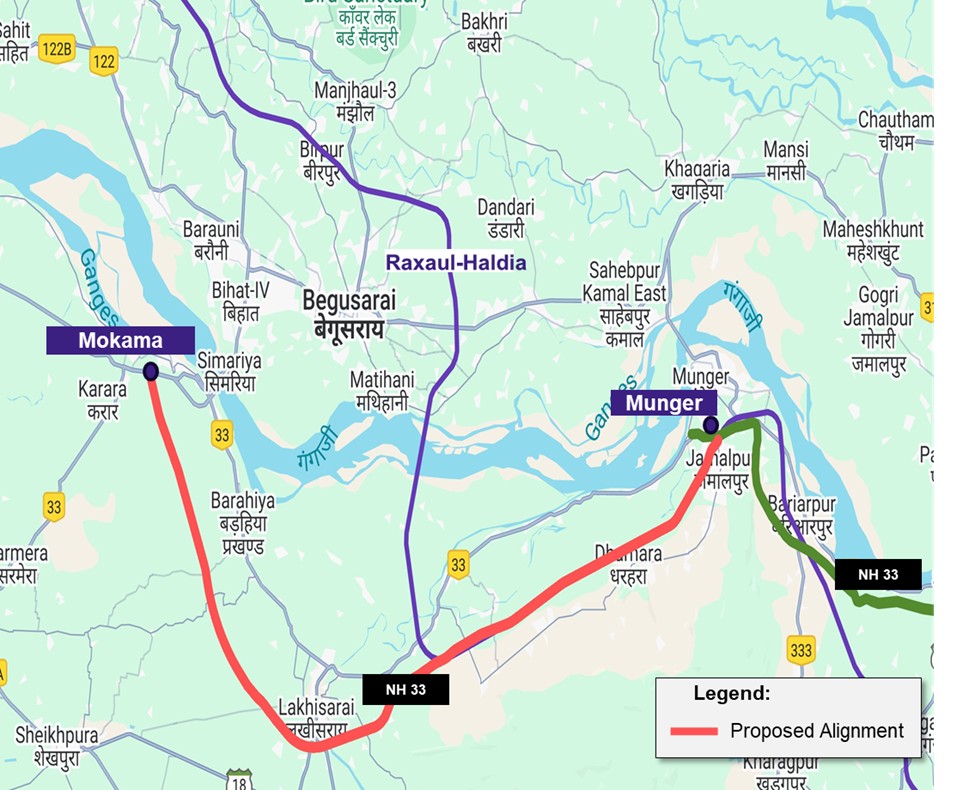
The first project involves the construction of a 4-lane greenfield access-controlled Mokama-Munger section of the Buxar-Bhagalpur High-Speed Corridor in Bihar. The 82.4 km stretch will be built at a cost of ₹4,447.38 crore. The second project is the doubling of the 177 km Bhagalpur-Dumka-Rampurhat railway line, connecting three eastern states, at an estimated cost of ₹3,169 crore. Both projects are part of the PM Gati Shakti National Master Plan and aim to boost multi-modal connectivity, improve logistics efficiency, and spur economic development.
Mokama-Munger Corridor
The new high-speed road will link key towns including Mokama, Barahiya, Lakhisarai, Jamalpur, Munger, and Bhagalpur. Designed for vehicles to run at an average of 80 km/h and up to 100 km/h, it is expected to cut travel time on the route to about 1.5 hours.
Officials said the corridor will serve the rapidly industrializing Munger-Jamalpur-Bhagalpur belt, which hosts ordnance factories, a locomotive workshop in Jamalpur, ITC’s food processing units in Munger, and Bhagalpur’s growing silk and textile sector. Barahiya is also emerging as a hub for food packaging and agro-warehousing.
The project is projected to create nearly 33 lakh man-days of direct and indirect employment, in addition to jobs arising from increased industrial and logistics activity along the corridor.
Bhagalpur-Dumka-Rampurhat Railway Line Doubling
Complementing the road project, the doubling of the single-line railway track between Bhagalpur, Dumka, and Rampurhat will enhance one of Indian Railways’ busiest routes. The 177 km stretch runs across five districts of Bihar, Jharkhand, and West Bengal, and will improve connectivity to 441 villages and a population of nearly 29 lakh.
The line will also benefit three Aspirational Districts—Banka, Godda, and Dumka—besides boosting religious tourism to destinations such as Baba Baidyanath Dham (Deoghar) and Tarapith.
Capacity augmentation is expected to handle an additional 15 million tonnes of freight annually, including coal, cement, fertilizers, bricks, and stone. The project will also have significant environmental benefits, reducing oil imports by 5 crore liters and cutting carbon dioxide emissions by 24 crore kg—equivalent to planting one crore trees.
Driving Regional Transformation
Both projects are expected to be transformative for Eastern India, providing faster mobility, improved trade routes, and stronger industrial growth. By integrating road and rail networks, the government aims to enhance accessibility, reduce logistics costs, and create sustainable employment opportunities.
Officials said the initiatives reflect the Centre’s vision of building a “New India” with modern infrastructure, greater self-reliance, and inclusive economic development.

 These Days Bureau